


How Did Iran Fight This War? Are there Lessons for India?

By Shokin Chauhan
Iran had long anticipated this war. The three-week transit of the USS Abraham Lincoln from the Western Pacific and the repositioning of American air assets gave Tehran ample warning.
On 11 April 2026, the collapse of U.S.–Iran talks marked the definitive end of diplomacy. The statement by U.S. Vice President JD Vance removed any lingering ambiguity; negotiations had failed, and the strategic contest had entered a more dangerous phase. As a senior Indian Army officer and long-time student of great-power conflict, proxy warfare, and war termination, I assess that the unfolding “no war–no peace” phase will shape outcomes far beyond the battlefield. It will test whether the United States, Israel, and the broader international community have truly absorbed the hard lessons of 21st-century expeditionary warfare.
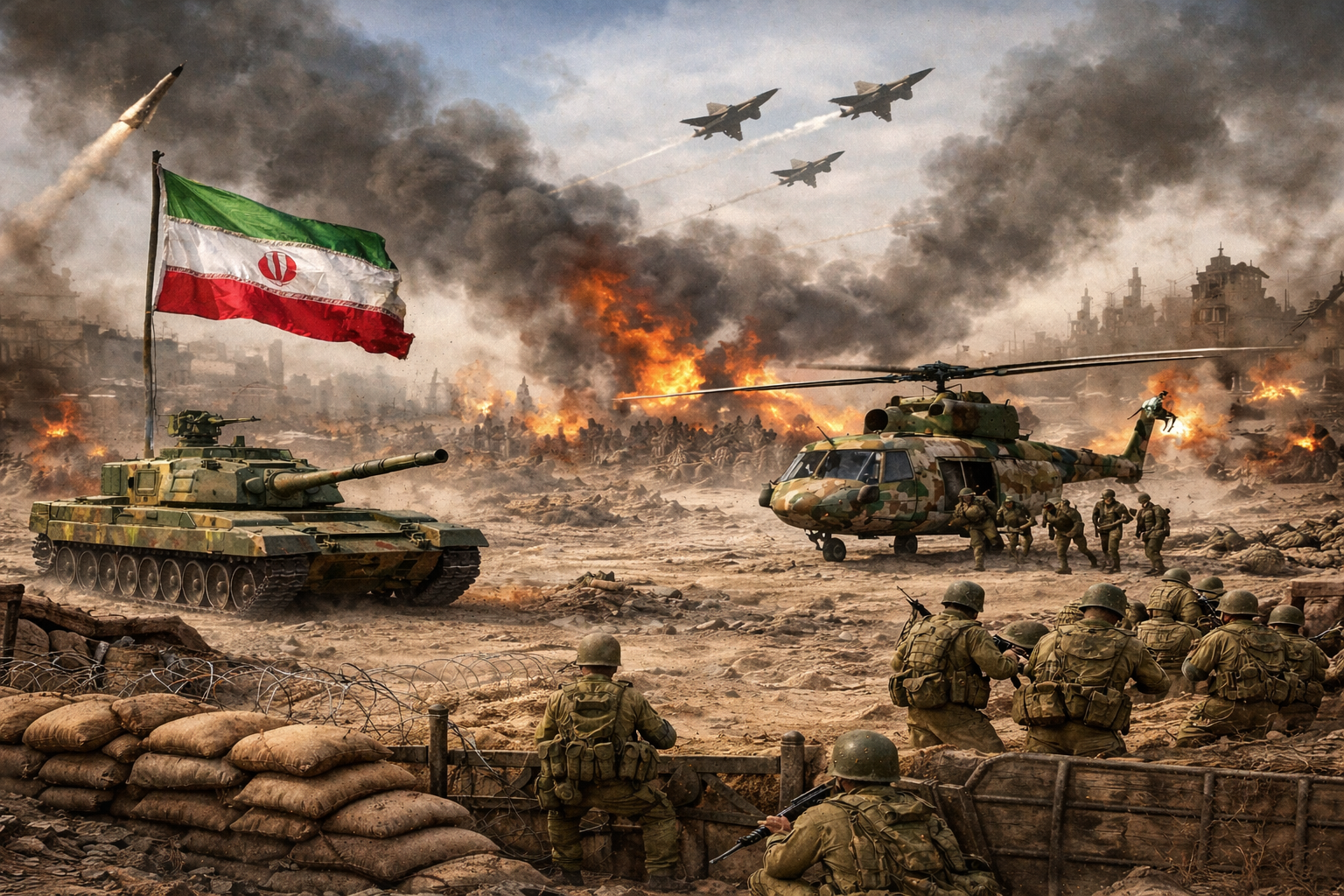
Iran had long anticipated this war. The three-week transit of the USS Abraham Lincoln from the Western Pacific and the repositioning of American air assets gave Tehran ample warning. It used that time wisely, surging production of low-cost Shahed-136 drones (priced between $7,000 and $10,000 and manufactured in the hundreds per month) and older missile stocks. Iran’s initial tactic was classic attrition: cheap, workable systems were sent forward to exhaust the far more expensive air-defence networks of Israel and the United States. Only once those defences were degraded did Iran launch its more capable follow-on strikes, including the audacious hit on Dimona. It also surprised Washington by expanding the fight to U.S. bases across the Gulf and, most dramatically, by imposing selective closure of the Strait of Hormuz, allowing Chinese, Indian, Pakistani, Turkish, and later Japanese tankers through while choking everyone else. The global energy shock was immediate and severe. The single greatest surprise, however, was Iran’s launch of two missiles with a claimed range of nearly 4,000 km toward Diego Garcia. Both were intercepted, but the psychological impact was profound. American planners had assessed Iran’s reach at roughly 2,000 km; this single demonstration forced a wholesale reassessment of Tehran’s technical progress.
Despite these tactical innovations, the hard truth must be stated clearly. In my assessment, the Iranian conventional defence forces were almost destroyed. Large segments of its navy and air force were obliterated, and its integrated air-defence system was systematically neutralised. What allowed the Iranian regime to continue functioning was not battlefield survival in the classic sense but its pre-planned “Mosaic Defence” doctrine. To understand Mosaic Defence, one must understand the deliberate dual structure of Iran’s armed forces created after the Islamic Revolution. Alongside the regular army sits the Islamic Revolutionary Guard Corps (IRGC), answerable directly to the Supreme Leader and organised to preserve the regime’s ideological survival. The IRGC mirrors every conventional branch and is explicitly trained to fight in a decentralised, survivable manner. Under Mosaic Defence, the country is divided into 31 autonomous commands, one for Tehran and one for each of the 30 provinces. In the event of leadership decapitation, these commands are designed to operate independently, executing layered defence without central direction. When Iran’s senior leadership was eliminated on 28 February 2026, the switch to Mosaic Defence was seamless. The Basij paramilitary force simultaneously maintained internal order, ensuring the regime’s core supporters remained mobilised while the wider population stayed largely indoors.
Are there lessons for India from this conflict?
The first three are familiar but still worth repeating: technology is an enabler, not a war-winner; resilience can offset material inferiority; and innovative employment of low-cost systems can blunt high-end capabilities. The fourth lesson in the public debate has been that removing a nation’s leadership does not guarantee regime change. I go further: regime change must never be a goal for fighting any war. History, from Iraq in 2003 to Libya in 2011, shows that pursuing it almost always produces worse strategic outcomes than the problem it was meant to solve.
In my own reflections on this war and a few earlier wars, I would emphasise three additional thoughts that I feel have not received sufficient attention.
Firstly, the Iranian defence forces were almost destroyed. The narrative of heroic resilience through Mosaic Defence is true at the operational and societal level, but it should not obscure the fact that Iran’s conventional military power has been broken and shattered. Any future Iranian threat to the world at large will be asymmetric, not symmetric. Secondly, we must ask ourselves what the concept of defeat or victory actually was in this conflict. The need for defining clear war-termination goals must be articulated at the very outset of any military campaign. In the absence of that definition, operations drift, costs mount, and political will evaporates. The United States and Israel appear to have entered this fight with the implicit aim of neutralising Iran’s nuclear infrastructure and, in some quarters, effecting regime change. Neither objective has been fully achieved, yet the price paid, in blood and global standing, has been enormous.
Thirdly, we must take a clear-eyed view of the regional aftermath generated by this conflict, particularly the effects of expeditionary operations undertaken by the United States and Israel. What is unfolding across the Gulf and the wider West Asian region is not an unintended by-product of war, but the logical extension of it. The disruption of existing power balances has created vacuums that are already being contested by a mix of state and non-state actors, each seeking to exploit instability for strategic gain.
The deepening of sectarian fault lines and the visible empowerment of non-state actors are especially concerning. These developments will outlast the immediate conflict and shape the region’s security architecture for years to come. Equally significant is the steady erosion of U.S. credibility in the Gulf. Partners and adversaries alike are reassessing Washington’s reliability, intent, and staying power. Such perceptions, once formed, are difficult to reverse and carry long-term geopolitical consequences.
It is therefore essential that nations contemplating similar interventions recognise that these outcomes are not collateral; they are predictable. Strategic planning must extend well beyond the initial phases of combat to include rigorous modelling of second- and third-order effects. Without such foresight, tactical success risks translating into strategic instability, with costs that far exceed any immediate gains.
The remaining public lessons: AI-enabled precision reducing casualties, fragile global supply chains, and the unifying effect of external aggression on a population remain valid. China’s quiet support, its integration of Iran into Beidou-3, and its methodical tagging of every U.S. and Israeli asset through Mizar vision all signal that Beijing is treating this war as a live laboratory for its own future doctrine, as it did during the earlier Operation Sindoor, fought between India and Pakistan. This time, however, India, wisely, stayed largely aloof, protected by strategic autonomy and focused on securing its energy supplies and its diaspora.
The way forward is difficult. The U.S. has announced a blockade of the Strait of Hormuz, yet its original goal of neutralising Iran’s nuclear capability remains largely unmet. Washington’s global standing has been dented, allied support was lukewarm, and the political cost to the Republican Party ahead of the November 2026 midterms is real and likely to be adverse. Iran, though crippled conventionally, will not abandon its nuclear ambitions; it has drawn the obvious lesson from Ukraine. Sub-conventional support to proxies and terrorism will likely increase. The Gulf states will probably further distance themselves from Iran. Weaker powers worldwide will study both Ukraine and Iran for lessons in the conduct of asymmetric war. Choke-point states from Taiwan to the Malacca Strait will note how Iran weaponised geography and how they could do it too.
Above all, this war reminds us that modern conflict is decided as much by geography, economic and population resilience, trade leverage, and clearly defined political objectives as by kinetic effects on the battlefield. As a senior defence officer and a strategic thinker, I urge the Indian leadership to internalise these lessons before the next crisis erupts. History does not forgive strategic ambiguity.
Conclusion: Clarity Over Capability
This conflict reinforces a fundamental truth: modern wars are not decided solely on the battlefield. Economic resilience, control of trade flows, and clarity of political objectives are equally decisive. Military power without strategic clarity leads to prolonged conflict and diminished returns.
For India, the implications are direct. Future conflicts, particularly in a multi-domain environment, will demand not only technological advancement but also doctrinal clarity, institutional resilience, and, above all, a precise articulation of political end states.
History is unforgiving of ambiguity. Nations that enter wars without defining victory rarely recognise defeat until it is too late.
The author is an Indian Army veteran. Views expressed are personal.